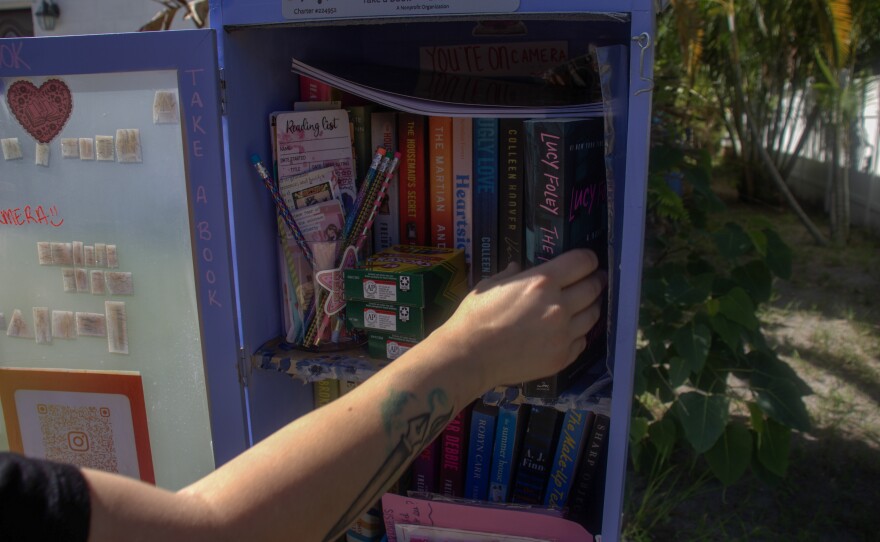
In St. Petersburg, a tiny cabinet shaped like a house sits on a wooden pole in Puryear Park.
The black paint on its borders is worn down, and the transparent door is slightly foggy.
But inside, Jack London’s “White Fang” sits at the bottom of a pile of books. Lemony Snicket's “A Series of Unfortunate Events” is tucked in a corner, and four of the five books from Lloyd Alexander's “The Chronicles of Prydain” series lean over where other publications once sat.
It’s a Little Free Library Maria Vickers adopted after she discovered it abandoned and falling apart at another park. The children's books Vickers drops off here move fast — she estimates that 30 to 40 books are regularly picked up by kids.
“I basically have to fully restock it every week,” she said, smiling.
Registered under the nonprofit of the same name, it’s just one of over 200,000 Little Free Libraries across 128 countries, which have shared over 400 million books. Hundreds of these libraries are scattered across the Tampa Bay area.
Vickers has a deep love for reading. She started last year with the goal of reading 12 books in 12 months, but after finding out she was a fast reader, the new goal became 200.
After running out of room to keep all the books she had read, Vickers said, she decided to make a Little Free Library to pass them on. She hopes to make other people excited to come across them and find a good book, just like the times she visited Little Free Libraries with her three-year-old daughter.
“They’re like happy accidents when you find them,” Vickers said.
While she stops by her Puryear Park Little Free Library once a week to restock, Vickers has two more in her front yard that she can check on more frequently.

Her first little library is painted teal and a lime green, with the Scooby Doo “Mystery Machine” logo painted on the side. Inside are a variety of thrillers — Vicker’s favorite genre — filled with tomes from authors like bestsellers Colleen Hoover and Ruth Ware.
A wrapped-up book labeled “Blind Date With a Book” lies on top of the others. Vickers said it’s a way “to get people to give a chance to a book” by lesser-known authors that people might not pick up based on the title.
In the corner is a pouch filled with bookmarks. Next to it, a card explains how the library works: take books, share books — and each one is always free.
Next to “The Mystery Machine” is a non-working mini-fridge covered in license plates from around the country, sitting on top of a pallet. The whole set-up cost about $3, Vickers said proudly.
It’s “by far the most durable out of the libraries that I have,” she said, and it’s great at keeping out the rain. Inside are all the non-thriller books, from Julia Quinn’s “Bridgerton” to Ransom Riggs' “Miss Peregrine's Home for Peculiar Children.” A jar of dog treats sits on the shelf, which has incentivized a neighborhood pet to drag its owner over to the library before, Vickers chuckled.
“People get involved. They just love them. It just warms my heart to see people stopping at them when they’re walking by.”Lisa Kothe
Along with supplying books to the one Little Free Library in Puryear Park and another by a local bus stop, Vickers said these tiny shelves have distributed almost 1,400 books since she started stocking them in March 2025.
Compared to regular libraries, the concept of these community-run libraries are “so wildly different,” she said.
“I feel like 'library' implies that you’re supposed to return the book,” Vickers said. “But I mean, not really with this one. You can just take it and go.”
Access to books in a state with increasing challenges
Last year, Florida ranked first in the country for book removals and restrictions in public schools for the third year in a row, according to the national free expression group PEN America. Thousands of books have been removed or restricted in recent years.
Reading gives children the opportunity to explore perspectives beyond what they’re used to, said Stephana Ferrell, the co-leader of the Florida Freedom to Read Project. Reading for fun can also help young people learn the concepts behind literacy comprehension, critical thinking and problem solving, she added.
Classroom libraries have shrunk their collections because of laws passed by the Florida Legislature in recent years, she said. They lost access to diverse books that reflected different communities, Ferrell added, “books that can connect with children.”
“Every child deserves an opportunity to see their lives reflected on the shelves, to be affirmed in their reading,” Ferrell said, “And to feel as if ‘this is a place for me to find comfort, to find support, and to keep on seeking out that love of reading.'”
While a Little Free Library’s collection of materials is based on the community using it, Ferrell said, it can benefit people by increasing book access and encouraging voluntary reading.
And if Florida voters pass Constitutional Amendment 3 on property taxes this November, Ferrell said budgets for public libraries may face funding cuts.
Little Free Libraries, which run off book donations, are a way to continue providing access to books that communities might lose due to budget or policy constraints, she added. Ferrell said she hopes they "are more of a band-aid in this moment.”
“(I hope) we don’t give up the fight to make sure that our libraries are there, our public libraries stay open and the collections (are) robust,” she said. “That our school libraries are supported and are able to provide those resources to students.”

Little Free Libraries offer a few things regular libraries can’t, Vickers said.
You need to be a resident to have a library card to check out books, she said — so if you’re visiting another area or are undocumented, you can’t take out books.
Traditional library hours also might not work for everyone’s schedules, Vickers said, and returning books on time can be a struggle for some people, which results in fines.
“Little Free Libraries just give a lot of solutions to problems that maybe most people don’t face,” Vickers said, “But for the people that do face those problems, it is really helpful to have that option.”
The stewards behind the books
In downtown Safety Harbor, a Little Free Library styled to look like a quaint pink house resides next to John Wilson Park. It’s one of Lisa Kothe’s favorites.
The former director of the Safety Harbor Public Library skimmed through the cabinet on a hot summer afternoon, noting “there’s some good books in here” — though all books are good, she added.

The pink house Little Free Library is just one of about a dozen the library system set up around the city in 2014. Over a decade later, Kothe said the libraries are still maintained — and appreciated — by the community.
“People get involved. They just love them,” she said. “It just warms my heart to see people stopping at them when they’re walking by.”
The little free libraries grew a life of their own, Kothe said, each one uniquely designed by crafty people.
Because they’ve been around for over a decade, she said, a lot of the Little Free Libraries have been replaced because they got worn out by weather and age. Volunteers have helped with maintaining and fixing them up, as well as keeping them stocked with donations.
“It just opens up more books for all,” Kothe said.
For some Little Free Library stewards, creating these little pantries of books is their way to make a difference for others.
Alexandra Tobey set up a Little Free Library in her front yard near St. Petersburg's Admiral Farragut Academy a few months ago. Painted lavender with “Alexandra’s story swap” written above the door, the two-shelved wooden library stands, surrounded by painted rocks.

During a period of anxiety and depression, Tobey said, going to Little Free Libraries became a reason for her to get out of the house. Those visits, though they were “something so small,” she said, “could make such a huge difference."
She decided to try and create that spark for other people, and the community has come together with trust and generosity when interacting with the boxes of books, she said.
“Everyone’s moving so fast these days, and it’s just like a chance to pause and slow down,” Tobey said.
Since she’s put up the library, Tobey said, people have donated more than just books. She’s found school supplies, like crayons and pencils, and even items like nail files and deodorant — though that doesn’t mean she’s short of space for books.
Tobey keeps the Little Free Library stocked with a lot of popular books, from psychological thrillers to books adapted into movies. Sometimes local authors even drop off signed books, she added.
Purchasing books can be expensive, Tobey said, and not every family has the extra money to buy them. She has seen a lot of mothers picking up books. Being a short walk or drive away from a Little Free Library can make a big difference, she said — especially when they can get a book for free.
“They’re running a whole family,” Tobey said. “They don’t have the time to get to the bookstore, to the library, and I’m in the neighborhood.”