

A large, steel ship bearing the name "Jose Gasparilla" has sailed into the heart of Tampa for generations.
Cannons boom as costumed "pirates" wave flags on their way to demand a key to the city. Along the shoreline, hundreds of thousands gather to witness Gasparilla — one of the largest outdoor celebrations in the country.
But how did a staged pirate invasion become a symbol for the city?
ALSO READ: What to know about the 2026 Gasparilla festivities
The Henry B. Plant Museum's special exhibit "Gaspar’s Gold: Carnival and Community in a New South City" seeks to answer that question.
The museum's executive director, Charles Groh, said it examines how traditions evolved and became central to Tampa's cultural identity.

How Gasparilla came to be
Gasparilla started in 1904 to popularize what was once the May Festival parade, Groh said.
According to Gasparilla's website, Tampa Tribune Society Editor Mary Louise Dodge was planning the event theme when George Hardee suggested the legend of Gasparilla. It involves Jose Gaspar — the infamous Spanish pirate — who invaded Florida's coast hundreds of years ago.
Hardee formed a krewe of 50 men. Then, the Tampa Tribune started publishing letters from Ye Mystic Krewe of Gasparilla that detailed an invasion by King Gasparilla and his court. In the first few years, the pirates appeared on horseback in the city. According to the city of Tampa, this did not become a seaworthy event until 1911.

The Gasparilla parade started on the site of the Henry B. Plant Museum, which was once the Tampa Bay Hotel. According to Groh, 1904 was also when the Florida State Fair was established. For around 70 years, Gasparilla and the fair were combined. He said the combination of events was part of the "secret sauce" that made this successful.
"It all centered on this location, and that provides us with an opportunity to look at how these traditions came into existence and evolved, and how that has really transformed our community's identity," Groh said.
An exhibit on some lesser-known Gasparilla facts

The exhibit is rich in artifacts from Ye Mystic Krewe of Gasparilla's royal crowns and coronation invitations to illustrations by John Gasthoff — known as the "dean of American float makers" and his son.
Gasthoff's business was in Tampa, and he started doing the Gasparilla floats in 1911 until he died in the 1950s.
"He created these grotesque heads that people would wear. And so there was a period of time as you go through the '30s, '40s, where the grotesque heads would be as significant as the marching bands or the parades," Groh explained. "But when you talk to younger people, that's not a part of their experience."
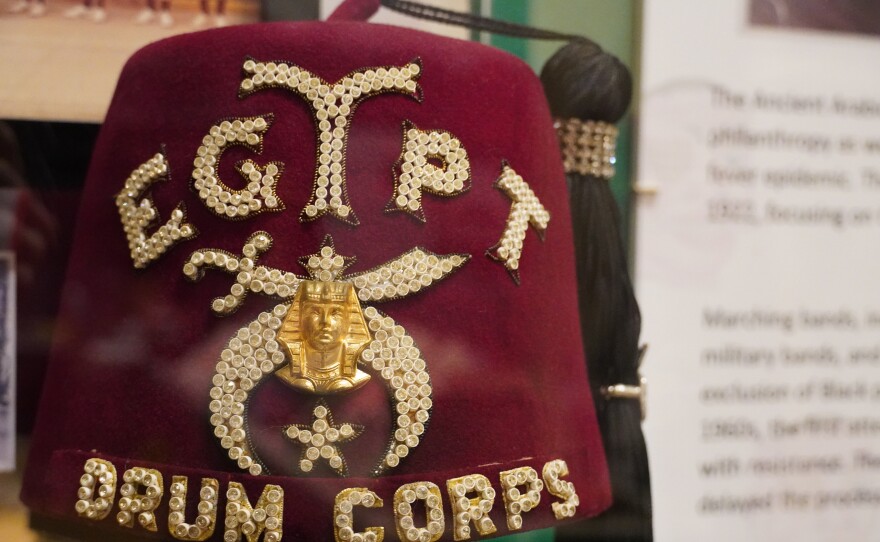
Aside from the Ye Mystic Krewe of Gasparilla, organizations like the Egypt Shriners have been part of the festivities. Groh said the Shriners participated in the May Festival parade before there was a Ye Mystic Krewe, and they were known for their hijinks.
"Men would ride camels, they would walk a bear. They would have what they called a pilgrimage that went from this property — the Tampa Bay Hotel — into Ybor City," Groh said.
In the early years, the "pirates" would proclaim their takeover in an ad in the newspaper. The Shriners "responded to their ad with a claim to repel the invasion with their superior numbers."



Also, a reason why Gasparilla became so widely recognized is that former First Lady Jackie Kennedy was photographed carrying a Gasparilla cookbook created by the Junior League of Tampa. She is also connected to a Tampa icon — the first famous African American fashion designer, Ann Lowe. She designed Kennedy's wedding dress and bridal party outfits.
But Lowe got her start as a seamstress for some women of means in Tampa, and started doing the Gasparilla gowns, Groh said.

The museum has the three oldest Anne Lowe dresses in the country and will be switching them out over the run of the exhibit.
"They can't stay on a mannequin very long because each individual bead is individually sewn into the garment," Groh said.
What should the meaning of Gasparilla be to the community?
In general, Groh said Gasparilla and the Florida State Fair were designed to promote Tampa's economic development. And Gasparilla should serve as a "recognition of the richness of our identity."
He described how Henry B. Plant — who established the Tampa Bay Hotel — was a big believer in promoting Tampa and Florida to the rest of the country. Groh added that Gasparilla and the fair have successfully served that purpose.
"It seems silly that a parade would serve that function, but it has, right? So that people across the nation basically have a sense of who we are," Groh said.
From the beginning, there's been a variety of groups that found ways to participate, he said. For example, the Latin American Fiesta Association, which started in 1927 and included Spanish, Cuban and even Italians.
"That's something really unique to our story in Tampa is that we do bring these really interesting cultures together," Groh said.


Gasparilla is similar to what you may see with Mardi Gras in New Orleans. Groh said that most cities at some point tried to have their own celebration, but "pretty much everywhere it failed."

Groh added that Gasparilla does have ties to Mardi Gras with its connection to the Krewe of Venus — the second Krewe formally recognized in Tampa. It started in New Orleans in 1941 as an all-women group and was then established in Tampa in 1965 as a co-ed Krewe. They were the ones to introduce beads into the event.
For the exhibit, Groh spoke with people in their 80s who grew up in Tampa, and they all told the same story. As kids, they'd walk with their packed lunches to find a spot to watch the parade — they even remembered the same floats.
"And then they talked about what, otherwise, to people outside of Tampa would sound so ridiculous that these little children would dive in between the floats to pick up empty shell casings from pistols that people were firing on the floats, right? And that's what they really remember as a central Tampa tradition," he said.
Traditions have evolved over the decades. He said that because people come from across the nation, "they don't always give it meanings that we really like." For example, having too much alcohol. Nowadays, there's a separate parade for kids to ensure it's appropriate. Groh said the children's parade happened after WWII.
"I do think for a lot of people now, there is a fondness to be looking back to earlier decades when the main Gasparilla parade was something that was more child-friendly," Groh said.
'Only time you get to experience the story'
When creating the exhibit, research always comes first. They have to "follow a formula" to ensure they tell authentic stories. But it also comes down to museum curation to showcase the story through objects.
"Nobody wants to come to a museum and read a book on a wall," Groh said.
So, they have 20 lenders for this show, including a descendant of John Gasthoff.

"It's also something that makes temporary or special exhibits really something you absolutely want to see because you're never going to see objects from these 20 lenders together again in a room," he said. "So this is the only time you get to experience the story."
The exhibit runs through Aug. 30. There are two scheduled speaking engagements with scholars and a partnership with the Tampa Theatre for a pirate-themed film series. Visit the museum's website to learn more.


