A pop-up exhibit called the "Museum of Unnatural Disasters," wrapped up in Washington D.C. on Sunday — it included hurricane survivors from the Tampa Bay region who shared their stories with visitors.
The mobile museum was parked in Constitution Gardens on the National Mall, where photos and artifacts were displayed from people who've lived through extreme weather events.
There were remains of a family heirloom vase found in the ashes of a California wildfire, and an Asheville-area road sign where Hurricane Helene brought catastrophic flooding.

ALSO READ: Tampa Bay area residents voice hurricane and heat concerns at a public hearing on extreme weather
Kimberly Wills is the director of strategic partnerships with the Climate Action Campaign, which put this together. CAC is a coalition of environmental health and justice organizations advocating for federal action on climate.
Wills said the point of this presentation was to connect these events to climate change.
"That can sometimes be perceived as an abstract problem for the future, but it is here, it is now. And we've got lots of people in town who can tell you exactly how painful it has been to their families,” she said.

When electricity means life or death

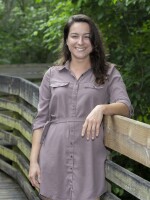
Carolina Gutfreund, 22, of Tampa, spoke to high school students about having Type 1 diabetes while living with the constant threat of losing power during a storm.
"I do require insulin daily to keep myself alive. Insulin is temperature sensitive and begins to degrade at 72 degrees Fahrenheit. So, if I were to lose access to electricity or refrigeration, I would be in a very dangerous situation," she said.
When a hurricane is headed for the Gulf coast, Gutfreund evacuates to her family home in Miami, where they have solar power, backed up with battery storage.
"I've had to structure my life so that I would be able to drop everything at a moment's notice and make this 300-mile drive, but that's really not something that is accessible or feasible for the average person,” she said.
"Something needs to change in the way that we respond to extreme weather, and the way that disabled people are expected to respond to extreme weather, because really it's an extreme cost burden to be able to redesign your life around this way."
Finding home again and again
Chelsea Rivera of St. Petersburg also told her story to museum visitors.
She was a teenager living in New Orleans during Hurricane Katrina, which separated her from her family for a while.
When her Catholic college-prep high school, Ursuline Academy, shut down indefinitely because of flooding damage, she tapped into a neighbor’s internet to find another location.
“I put the laptop on the roof of my grandma's car, climbed up on a ladder, and found that there was like an Ursuline in St. Louis,” Rivera said.
With a packed duffel bag, her family took a road trip to the St. Louis home of the Goodwillies, a family who took in hurricane survivors.

The separation was particularly hard on Rivera’s father, who was a Cuban refugee from Operation Pedro Pan when thousands of unaccompanied minors were brought to the U.S. in the early 1960s.
“It was really, really traumatic for him, and so he had promised that he would never do that to his own child, so I think he felt really, really torn,” she said. “I remember he like broke down to the nun at the school … it was very interesting to see kind of like this full circle moment.”
She’s stayed in touch with her St. Louis “hurricane family” — they even attended her wedding.
ALSO READ: Extreme heat is increasing health risks for pregnant Floridians
Rivera also reflected on a moment with a school friend named Jessica Barnes before the storm hit.

"On the Friday before Katrina made landfall, we had volleyball practice, and we like played like normal, and was like, see you on Monday, and the hurricane hit on Sunday, and I never saw her again,” she said.
Her friends' home was destroyed, and the family left the state.
A few years ago, they reconnected in St. Petersburg.
“We grabbed some drinks, and she now back to being one of my best friends,” Rivera said.
The pair traveled to Washington, D.C., together to take part in the exhibit.
Rivera said talking about that time is part of her healing process.
“We're all on the front lines of this climate disaster … we're not sounding like a 911 to instill panic, but just to inform of like this is real,” she said.
“It doesn't matter what your political contributions were that year, or how much you net, or who's in your pocket for the politicians, like your home is your home, and your family's your family, and you don't want to see that be hurt. So, for me it's important [to] give a relatable story to some of our policymakers," she continued.
There was an interactive part of the exhibit which asked people to consider and write down: "What would you save from your home if you had to evacuate?"