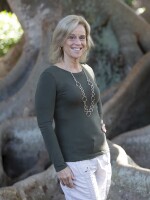
Artist Janet Echelman creates large-scale, aerial sculptures that blend art, architecture, and engineering.
The unlikely materials she uses to create her works range from atomized water particles to engineered fiber fifteen times stronger than steel.
And when the wind blows — or the light hits just the right way — her art transforms.
Echelman’s flowing fiber sculptures have been installed throughout the world, including the temporarily closed "Bending Arc" at the St. Pete Pier.
Now, the Tampa-based artist is the subject of a mid-career retrospective at Sarasota Art Museum.
On "Florida Matters Live & Local," WUSF's Cathy Carter recently met up with Echelman to talk about her work.
The interview below has been edited for clarity and brevity.

Janet, early in your career, you won a Fulbright scholarship to India. We now know you for your fiber art, but at this point, you were painting. You had been commissioned by the U.S. Embassy to do some shows. I understand that when you arrived in India, your art materials did not. Can you tell us how that story shaped your work?
It was truly horrible because I was a young artist and this was my big break. Exhibition halls had been booked at museums all around the country, and all the pressure was on, and I had no materials.
I kept waiting for something to arrive, and I finally realized that maybe it wasn't ever going to arrive. So, I could either hit my head against the wall, complaining about what wasn't there, or I could just look around me and embrace what was.
I was in the south of India, which is famous for bronze casting, and I had never made a sculpture, but I thought, OK, I will apprentice to these bronze casters. So, I'm working away, and finally, it was only eight weeks till the show was going to open, and I had only, like, a half dozen bronzes the size of my hand.
And I thought, well, I want to just extend those gestures large, and I started calculating how much money I would need to buy the raw material, just the bronze, and I just didn't have it. And every day I would take a walk on the beach, and I would watch the fishermen. At the end of their workday, they were weaving their nets with knotted twine, and they were sort of folding them into mounds on the sand.
And suddenly I looked at that, and I thought, "I can't afford bronze. Look at that. That's volumetric form without heavy, expensive, solid material." And so, I reached out to the fishermen, and they taught me how to make knots, and I started working with them. I took those bronzes, drilled holes in the bottom of them, and then made these knotted sculptures that just continued on and on, and then I could fold them up afterwards, because, in fact, I didn't have a shipping budget, so they had to all fold into one crate. So that's how I became a sculptor, really, by mishap.

As an artist, you are required to think logistically and practically because of the engineering. How do you keep that separate from your creative vision. Or is it separate?
It's not separate. My first time working with an engineer was in New York, creating a piece for the Armory Show, and it was such a struggle. The engineer that I was assigned to just kept saying, "Just tell me what you want, lady."
And I kept saying, "That's not how I work, I need to understand what is possible, and that helps me determine the range of things that I want."
And it's this back and forth of collaborating and finding new opportunities together. That is what really leads my work. So, I have such close relationships with my engineers, and we work on, you know, half a dozen pieces at the same time, all over the world.
Janet, I first discovered your work in 2015 in Washington, D.C., at the Renwick Gallery. It was so magical and even Oprah Winfrey's magazine had you listed at number one on a list of things that 'make you go, wow.’
Yeah, that was such a surprise. That project that you stumbled upon is part of my Earth Time Series, and here at the Sarasota Art Museum, you can see the early physical maquettes that I designed in the process of evolving that work.
And that was one of my first pieces coming from data sets about our planet and our human interaction with nature, and making that into these experiential works, where you are underneath it, and it moves and changes as the projection of colored shadow drawings moves around you on the walls.
And so here at the museum, you can see the shadows. You can see the work at different scales. There are small works the size of maybe both of my arms outstretched to works that are 16 feet, and you can see video of the works that are 100 feet, like the one that you were inside of in Washington, D.C.

I'm glad you said inside of, because that's what the experience was like, being inside one of your pieces.
Well, that's very important to me. They are immersive. I don't think of sculpture as an object that you look at. For me, it's something you can get lost in. That's what I want myself as an art experience. So that's what I want to give you.
And Janet, at Sarasota Art Museum, you have something that we've never seen before, which has to do with photography.
It's Cyanotypes, which is very new for me, but in fact, it's one of the oldest forms of photography. It's a direct exposure of sunlight onto a light-sensitized paper, and it's the first time I'm able to share work using the three-dimensional models on the computer. So, maybe I should step back a minute.
Now that I build sculptures at the scale of buildings, I have to create very accurate three-dimensional models. This required my studio to commission computer scientists around the world, because this turns out to be non-trivial, to model how each piece of twine and knot exists in three-dimensional space, how they change with gravity and with wind.
So, this has taken more than a dozen years, and as an artist, I never expected to have to be like a technology entrepreneur, but it turns out I have. So those models have never been visible to the public before.
My friends complain a lot that I make really large art that maybe a city can commission, but that people can't really have in their homes. So, that pushed me to think about what I could create that was the size that could fit in your home. It's the world premiere of cyanotypes, which are created from the digital reality of my work. So here you get to see this nature that is completely created digitally.

I'd like to ask you a question about a sculpture of yours that was at the St Pete Pier. It came down after the hurricane. The city of St Petersburg had commissioned that work. It's called ‘Bending Arc.' What's going on with the piece now?
Well, I'm glad that I have good news to share. They are hoping to get it refurbished and back within six months. So, fingers crossed.
I do want to clarify what happened. The City hired a national engineering firm, Stantec, to analyze what happened during the hurricane, and the report, which is public record, showed that my sculpture was properly engineered, and there was no fault at all with the sculpture; the cause was the lashings that connected my sculpture to the structural ropes above it.
The city hired a contractor, and basically, they didn't follow the instructions, and they use substandard materials and a quicker, faster method that, when the hurricane hit, didn't survive. So, it really was just a separation of the net sculpture from that structure.
So, it is repairable. They are on it, and hopefully it will get back for the public to enjoy very soon.

Janet Echelman: Radical Softness runs through April 26 at Sarasota Art Museum.