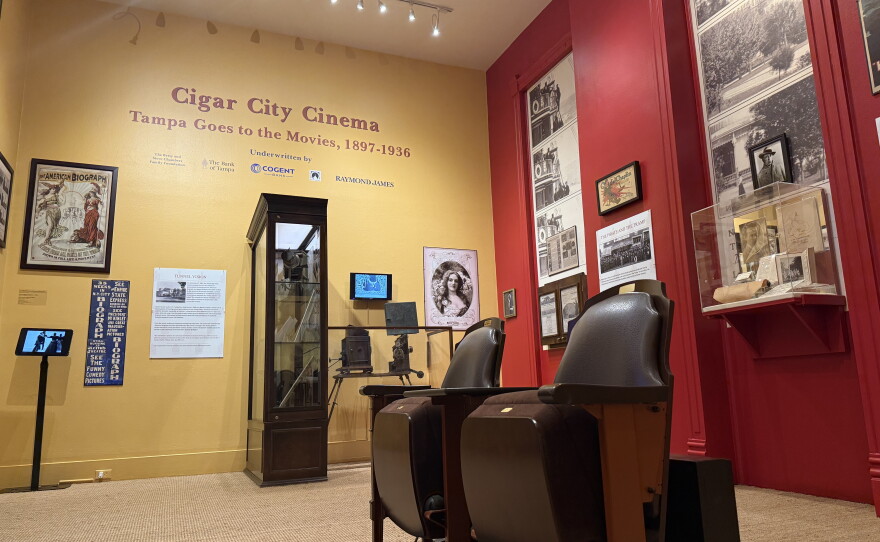
A new exhibit in Tampa traces the city's cinematic history back to the 1890s.
It opened to the public on Oct. 3 at the Henry B. Plant Museum, formerly the Tampa Bay Hotel casino, which was the first place in town where people went to the movies.
ALSO READ: How are Tampa Theatre's renovations going ahead of its 100th birthday? Its new CEO explains
It predates even the Tampa Theatre, which is preparing for a grand reopening after months of restoration and its 100th anniversary on Oct. 15.
WUSF's Gabriella Paul recently explored the exhibit showcasing Tampa's early decades of film along with the museum's director, Charles Groh.
This interview transcription has been edited for clarity and length.
So, where should we start?
"So, let's start right here, actually. Most of what we're going to talk about is going to the movies in Tampa, but the Tampa story actually starts a little bit earlier. So William Dixon, who is the brilliant man who invented the film roll motion picture camera, took some of his earliest film in Tampa, and specifically here at the Tampa Bay Hotel Casino. So, one of the things that we've done is put up a number of still shots from these very, very early films, so that people can see that Tampa has always been at the center of the story, right?"
Yeah, and so we're looking at 12 still shots here, and for those who haven't looked into early cinema history at all, what kind of films are we talking about here?

"Well, they're surprisingly modern because when you go back to the first film, they look a lot like what you would see on TikTok, except they're silent because early films could have been 23 seconds; they could have been a minute, and they're really designed to just record something about life — as opposed to being a big story.
"One of the short films that was taken on the property here at the hotel in the mid 1890s was literally the waiters taking a break from the dining room and having a cockfight outside."
That's cinema.
"Exactly. So, the (motion picture) camera was invented in 1895, and we know that this was sometime between then and when the American Mutoscope and Biograph Company started releasing these small films."
So in a way, the history of cinema, whether it's in Tampa or somewhere else, was just kind of this series of feats. And the first one was: how realistic can we make it?
"Yes. And that's really important. Actually, if you look here at this newspaper article, this was one I really like. There was this really famous prize fight that takes place in the early 1900s ... and people were really excited in Tampa to go see film of this ... because they didn't believe that reporters could write about it accurately."
Uh, ouch...
"Right, and so the only way to actually experience something is to see it on film. Early films were actually called actuality films because the idea was that you can see for yourself. It's like looking through a window, right?
"And then it's only over the course of time, which is what we see in the exhibit, where people are going to see is actually a narrative-like, storytelling experience.
"The Tampa Bay Hotel Casino did evolve to showing feature-length films. And by the time we get into the 1910s, they are showcasing some films by D.W. Griffith. He really is considered by many to be the father of modern cinema, or as Spike Lee calls him: the father of modern racist cinema. But definitely kind of problematic. "
ALSO READ: The Tampa Theatre is in line for a $14 million facelift
Important distinction.
"Yeah, but Tampa audiences did see the film "Birth of a Nation" here, which is a film that is based on a book, The Klansman, that really celebrates the rise of the Klan as a response to Black freedom during Reconstruction. Here's this flyer advertising the film, and I think the thing that's most important here is that line where it says that it's true, right?
"Because when people first started going to the movies ... they're basically set up to think that they're true, and so this story basically says 'slavery was wonderful ... slaves were happy, the Civil War ruined everything.' This is being described to people as like reality, and so it's an important moment, I think, because African Americans in the United States realize the power of propaganda as an element of what film is becoming ... and this is actually the same year that the NAACP comes into existence in Tampa."
When's the first time that a moviegoer in Tampa would hear sound?
"So, that's actually something that we talk about in relation to the early years of Tampa Theatre. The Tampa Theatre opened to the public in 1926. So, 1928 is where you see the first sound films. For the Tampa Theatre, this film, "Mother Knows Best," is the first talking film that doesn't survive from this era.
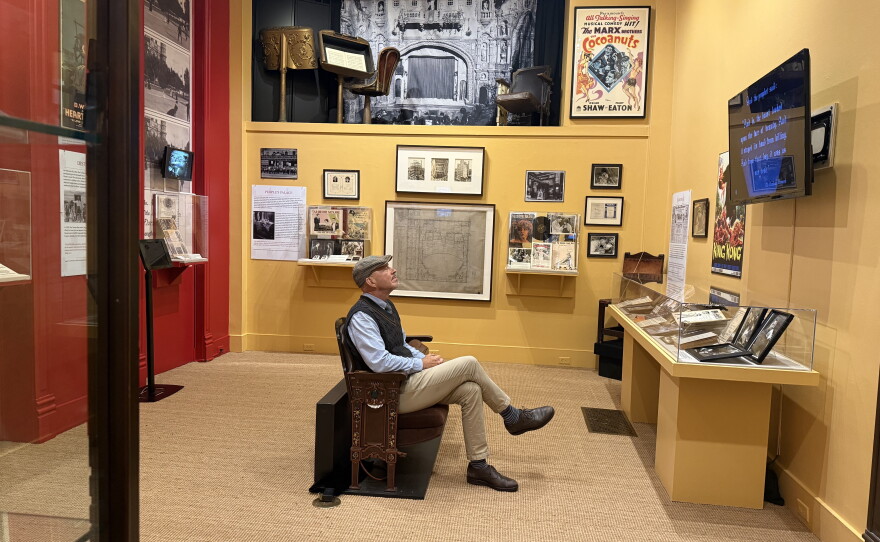
"There's still a lot of emphasis on music, right? "Cocoanuts" has music numbers by Irving Berlin. If you look behind you at that astonishing original Marx Brothers "Cocoanuts" poster, that's an original poster. That's not a copy, and that was lent to us from New York because it's a really important film to us."

Were any big movies from this period filmed in Tampa?
"Tampa doesn't really kind of enter into the filmmaking part of the story again until "Hell Harbor." It's an adaptation of a novel that takes place in Cuba. So, they film at Rocky Point. In 1929, the film was released and in 1930, and the film doesn't actually do that well ... but it's still really important for people in Tampa. I mean, there were like tons and tons of people who were extras from Ybor City.
"So this chair is actually from J.C. Newman Cigar Factory. The reason why we wanted this chair is that there's this bar fight in the movie, and they didn't break fake chairs. They actually used real chairs from the Ybor City cigar factory. "
Looking back at early cinema in Tampa, what has changed the most about the movie-going experience?
"You could go to the movies whenever you wanted to. You didn't go at a particular time. I mean, the ushers would be constantly seating people, and people are there for as long as they want to be ... And then even more importantly, this was a really safe space for a woman to be unaccompanied, and it was also basically daycare."
So this is like early 1900s version of, like, iPad Kids?
"Yeah, but it also I think it's really really important because ... you know the multiplex is not in great shape these days, right? It's you know Nicole Kidman can like do as many ads as she wants, but it's not just about the movie. I mean, movie theaters used to have a lot of community functions, right?"